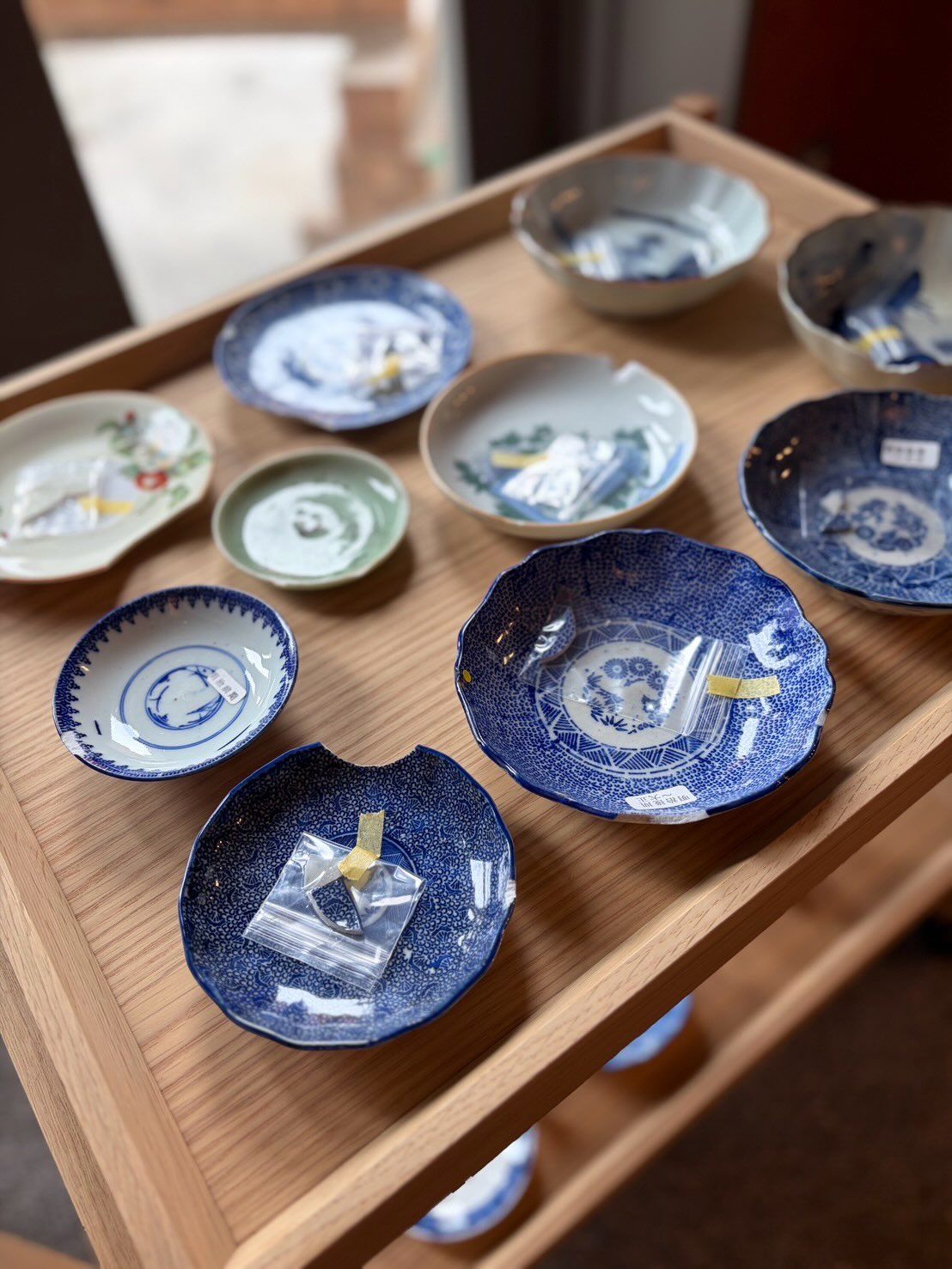
Kutani ware
Kutani ware is overglaze-painted porcelain from southern Ishikawa Prefecture. It is known for bold, vivid decoration in the “Kutani gosai”, five colours: green, yellow, purple, deep blue and red. Unusually, it died out after only about 50 years and was revived roughly a century later.
Why porcelain began in Kutani
Kutani ware began in the mid-17th century, when porcelain stone was found in the village of Kutani (today part of Yamanaka Onsen in Kaga). The area belonged to the Daishoji domain, ruled by a branch of the powerful Maeda family of Kaga.
At the time, Arita in Kyushu was the only place in Japan making true porcelain, and imports from China had fallen because of turmoil there. The Maeda saw a chance to create a local porcelain industry, and with the domain’s support a kiln was built in Kutani.
Ko-Kutani: fifty brilliant years
Early Kutani ware made from around 1655 to the end of the 17th century is called Ko-Kutani, “old Kutani”. Arita had begun overglaze painting in the 1630s, and Ko-Kutani was strongly influenced by it. Designs were outlined in black and covered with thick glaze to give deep, bold colour.
Ko-Kutani falls into two main styles: iroe or gosaide, using all five colours and leaving some white showing; and aode, which omits red and covers the whole surface in two or three colours, often with fine patterns on a yellow ground.
The Ko-Kutani kiln stopped production around 1700. Because the kiln was small and short-lived, few genuine pieces survive, yet artists and scholars regard them as masterpieces of the highest order. The kiln site is a National Historic Site.
Revival a century later
About 100 years after Ko-Kutani ended, in the early 19th century, the Kaga domain encouraged porcelain-making again in Kanazawa and Komatsu. Kutani ware from this time on is called Saiko-Kutani, “revived Kutani”.
Among these, the Yoshidaya kiln was built by a wealthy Daishoji merchant next to the old Ko-Kutani kiln and later moved to the hot-spring town of Yamashiro. Its work is praised as approaching Ko-Kutani in artistry and quality. Because later potters recreated and developed the Ko-Kutani style, its colours and motifs remain central to Ishikawa ceramics today.
What makes Kutani ware distinctive
Kutani’s hallmark is lavish overglaze painting: the five Kutani colours — red, yellow, green, purple and deep blue — on white porcelain. The rich, red-free palette of aode is unique to Kutani.
Kutani ware was designated a Traditional Craft of Japan in 1975. New expression keeps emerging, such as the yuri-kinsai technique of Living National Treasure Yoshita Minori, who uses gold leaf to create depth beneath the glaze.
How to choose and care
Wash overglaze-painted pieces gently, without abrasive sponges, and never microwave pieces with gold. Kutani makes many small plates and dishes, which make an easy first piece.
Sources
MAKERS
Makers
FAQ
FAQ
What is Kutani gosai?
The five colours — green, yellow, purple, deep blue and red — that form the base of Kutani painting.
Is Kutani ware microwave safe?
Pieces with overglaze painting or gold should not go in the microwave or dishwasher.
Is Kutani ware an official traditional craft?
Yes, designated in 1975.