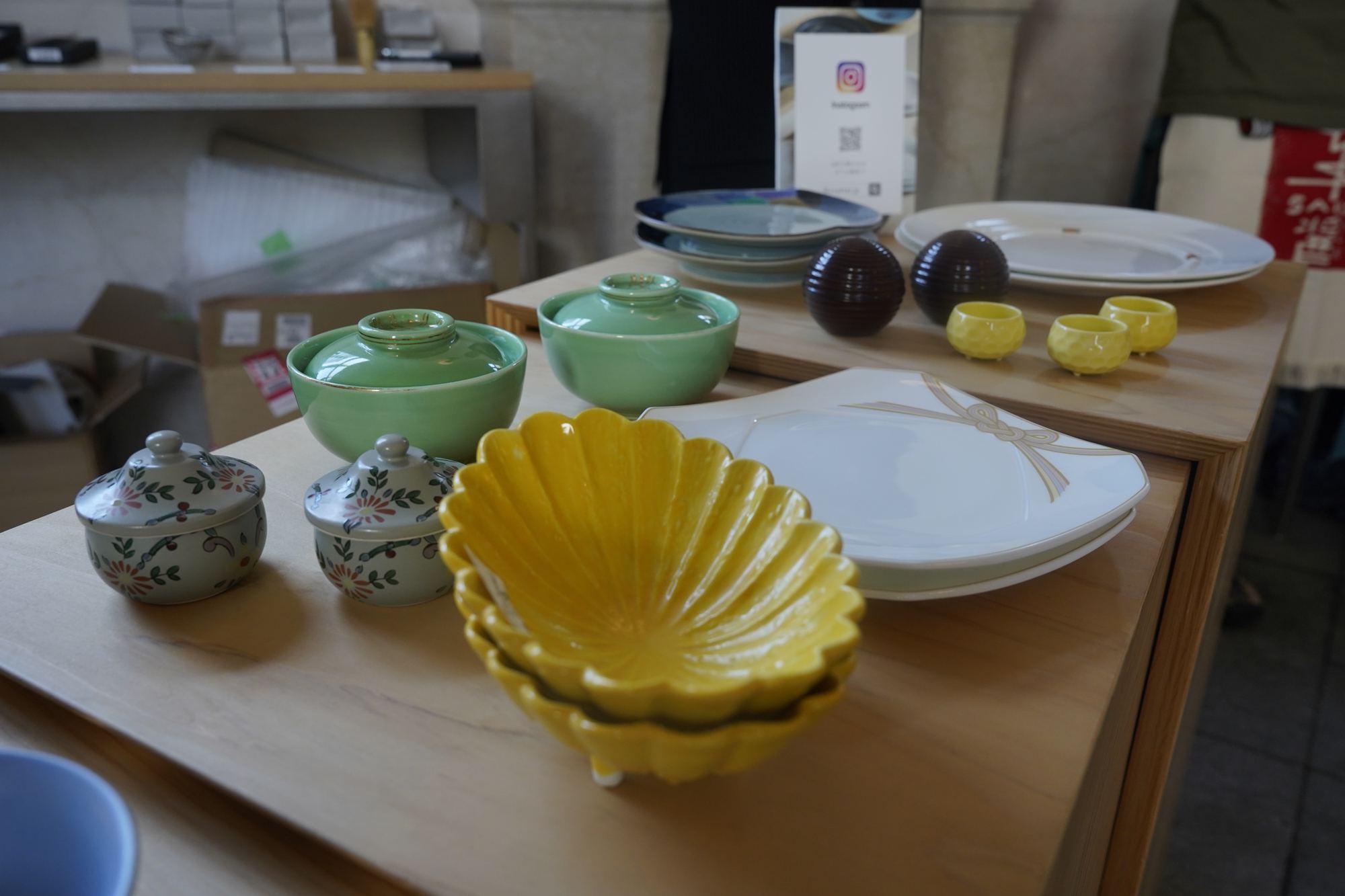
Hasami ware
Hasami ware is porcelain made in Hasami, Nagasaki Prefecture. Its simple, easy-to-use white pieces with blue decoration are hugely popular, and Hasami is now one of Japan’s leading makers of everyday tableware. Though it has over 400 years of history, its name has only become widely known in the last decade or so.
Why porcelain grew in Hasami
Hasami sits on the prefectural border next to Arita in Saga, famous for Arita ware. The town centre is flat, ringed by low hills in a basin-like landscape, and the hills to the southeast yielded porcelain stone.
Pottery-making here is said to have begun in the late 16th century. In 1599, after Omura Yoshiaki, lord of the Omura domain, brought potters back from the Korean campaigns, climbing kilns were built. The kilns first made stoneware, then moved to porcelain once its raw materials were found.
Hasami and Arita were really one production area, sharing skills, materials and people. Within it, Hasami — with terrain suited to large kilns and plenty of porcelain stone and fuel — grew into a maker of everyday porcelain, while Arita, under the Saga domain’s protection, made gifts and export ware.
Kurawanka bowls and porcelain for the people
In the mid-17th century, while China was in turmoil during its change of dynasty, Hasami also exported porcelain to Southeast Asia. But exports stalled in the 18th century.
From around 1690, demand for everyday bowls and plates surged, and Hasami built a system of divided labour and mass production to meet it. In the late Edo period, simple “kurawanka” bowls spread to ordinary tables. Hasami made porcelain, once a luxury, affordable for ordinary people.
In the shadow of the “Arita” name
From the Meiji era, Hasami’s ware was sold as “Arita ware”, after Arita, the railway station it was shipped from. Much of what was called Imari or Arita ware was actually Hasami ware.
Later, as origin labelling became stricter, pieces made in Hasami began to carry the name Hasami ware. Its simple white porcelain was then noticed for its affinity with Scandinavian design, and its popularity took off.
What makes Hasami ware distinctive
Hasami ware is pottery for everyday life. The classic piece is clear white porcelain painted in gosu cobalt blue, but Hasami is not bound to one style: it makes casual, stylish, practical tableware that follows the times and what people need.
Production is divided among mould makers, body makers, kilns and trading houses. This efficient system delivers good-quality pieces at reasonable prices. In a town of about 15,000 people, 20–30% work in ceramics.
How to choose and care
Most Hasami ware is microwave- and dishwasher-safe, ideal for everyday use, and many pieces are designed to stack. Only pieces with gold or silver decoration should be kept out of the microwave.
Sources
MAKERS
Makers
FAQ
FAQ
What is the difference between Hasami and Arita ware?
Both are porcelain. Arita also has a tradition of presentation and art pieces, while Hasami developed around everyday tableware.
Is Hasami ware dishwasher safe?
Much of it is, but some glazes and gold decoration are not. Check each item.
Where can I buy Hasami ware?
From kiln and trading-house online shops, and at the Hasami pottery fair held each spring.