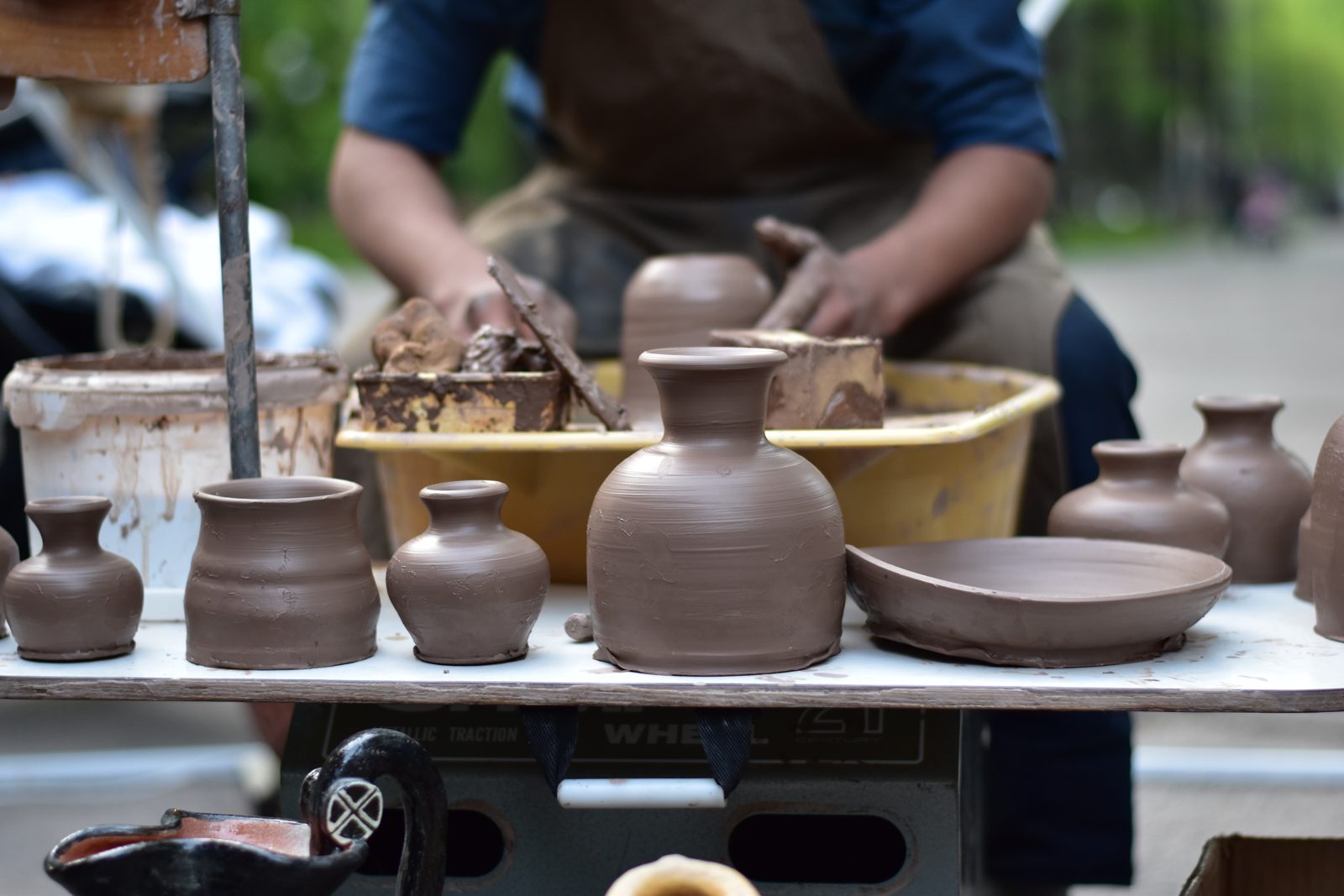
Bizen ware
Bizen ware is pottery made around Imbe in Bizen City, Okayama Prefecture. Regarded as the oldest of Japan’s Six Ancient Kilns, its kilns are said never to have gone cold in nearly a thousand years. Fired without glaze or painting, using only clay and flame, it is one of the most elemental and powerful of all Japanese ceramics.
Why pottery grew in Bizen
Bizen ware’s roots lie in Sue ware, a firing technique brought from the Korean Peninsula in the Kofun period. Many Sue ware kiln sites from the Kofun to Heian periods remain between southern Bizen, Setouchi and Okayama, and these are thought to be the source of Bizen ware. Ceramic skills had deep roots here.
The other reason is clay. From the late Muromachi period, the main material became hiyose, a local iron-rich, highly plastic clay dug from beneath rice paddies. It gives Bizen its distinctive colours and surfaces.
From storage jars to tea masterpieces
Bizen ware has continued unbroken from the late 12th century, the end of the Heian period, to the present. In the late Kamakura period it took on its characteristic reddish-brown colour and was widely used for great storage jars, pots and mortars.
In the Momoyama period its plain, unadorned beauty matched the wabi-sabi spirit of the tea ceremony, and potters began making water jars, flower vases and sake flasks for tea. Tea wares from this era are still treasured.
“Back to Momoyama Bizen” and Living National Treasures
In the modern era, led by Kaneshige Toyo, regarded as the restorer of Bizen ware, potters rallied under the motto “Back to Momoyama Bizen”. Living National Treasures followed one after another — Fujiwara Kei, Yamamoto Toshu, Fujiwara Yu, Isezaki Jun — and Bizen flourished again.
Today there are some 20 kilns centred on Imbe and more than 250 artists living and working nearby. Bizen ware was designated a Traditional Craft of Japan in 1982, and in 2017 became part of the Japan Heritage designation for the Six Ancient Kilns.
What makes Bizen ware distinctive
Bizen is high-fired without glaze or painted decoration. Bizen clay has low heat resistance and shrinks a lot, so it cracks if the temperature rises too fast. Potters therefore raise the kiln temperature slowly, and firing lasts one to two weeks.
Over this long firing, flame, ash and placement create yohen, kiln effects: hidasuki, red lines left by straw wrapping; goma, ash melted into sesame-like flecks; botamochi, round marks where smaller pieces sat on top; and sangiri, grey or blue areas buried in ash. Nothing is left purely to chance: potters plan each piece’s place in the kiln around the path of the flame and the fall of the ash.
How to choose and care
Bizen ware is hard-fired and durable. It is said to give beer a finer head and keep flowers fresh longer, so beer mugs and vases are popular. Rinse pieces in water before use so they stain less.
Sources
MAKERS
Makers
FAQ
FAQ
Is Bizen ware glazed?
Generally not. Its colours and patterns come only from the clay and the fire.
What is hidasuki?
Red lines left where straw was wrapped around a piece during firing.
Is Bizen ware an official traditional craft?
Yes, designated in 1982.