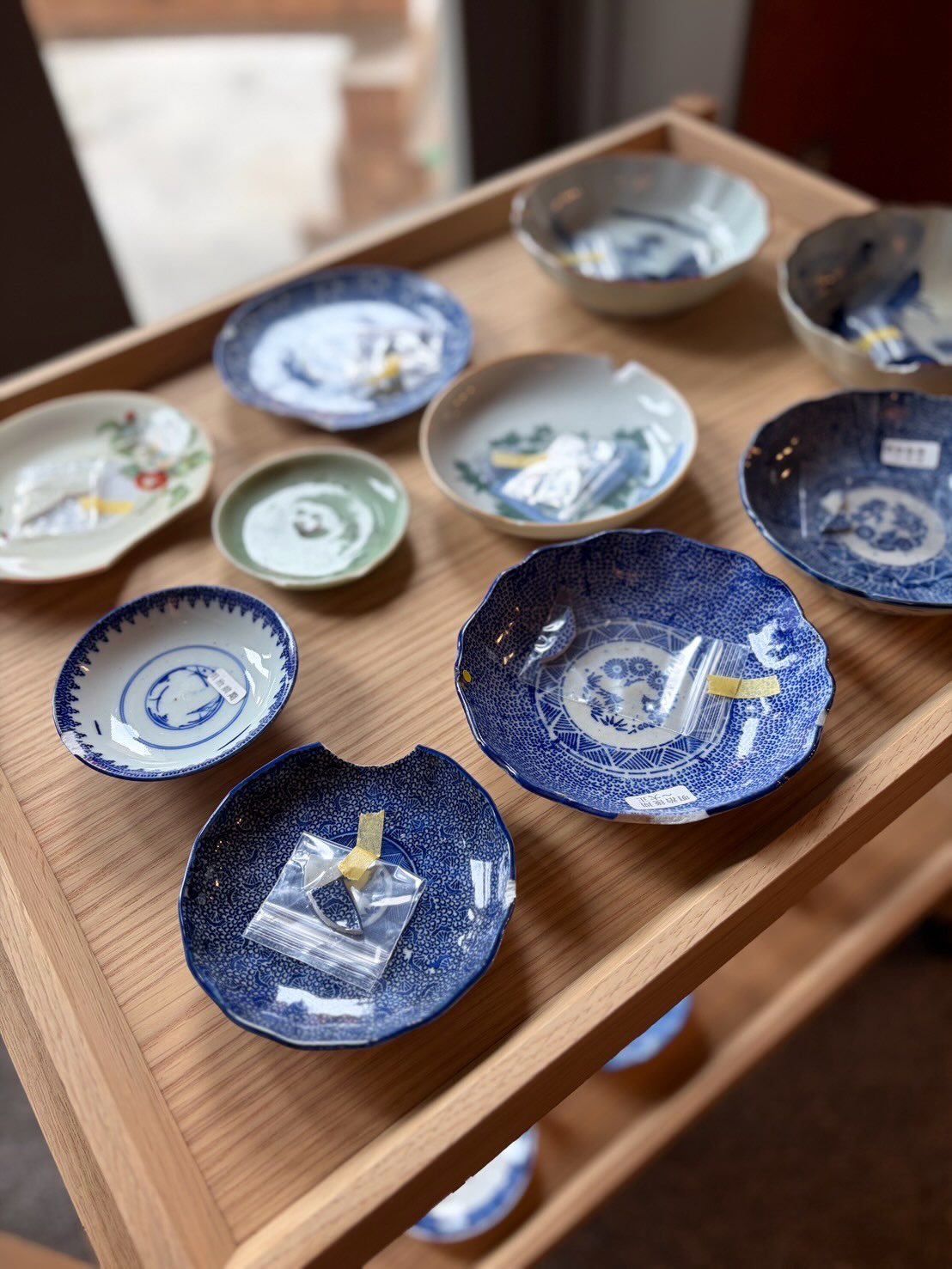
Kintsugi
Kintsugi is the Japanese art of repairing broken or chipped ceramics with lacquer and finishing the joins in gold. Rather than hiding the damage, it displays it as part of the object’s history — an idea that now resonates around the world.
Lacquer repair since the Jomon period
Repairing vessels with lacquer goes back a very long way, to the Jomon period, when lacquer was used to mend pottery. Lacquer is tree sap that, once cured, is strongly adhesive and water-resistant, and Japan has long had the skills to work with it.
Born with the tea ceremony
Accounts of kintsugi’s origins vary, but the leading theory places it in the Muromachi period, closely tied to the tea ceremony. Ashikaga Yoshimasa, the eighth Muromachi shogun, retired to Ginkakuji in Kyoto’s Higashiyama and promoted Zen-influenced arts such as tea and flower arrangement.
Tea bowls were at first mostly imported from China and Korea and extremely expensive. Joining broken or cracked bowls with lacquer and decorating the joins with gold using maki-e techniques is thought to be how kintsugi began. Repair raised a bowl’s standing, and the joins came to be admired as a “landscape”.
The story of Bakohan
A story often told about kintsugi involves Bakohan, a celadon bowl now in the Tokyo National Museum. Yoshimasa is said to have prized it, and when its base cracked he sent it to Ming China for a replacement. Told no such bowl could be found, he received it back mended with metal staples, which looked like locusts — hence its name.
Recent research has cast doubt on the Yoshimasa episode. Either way, the story is still told because it captures a Japanese sensibility that finds value in the repair itself.
What makes kintsugi distinctive
Kintsugi decorates the joins with gold, silver or red and enjoys the scars as a landscape. Tea masters likened golden lines to “flowing rivers” and found in them the beauty of wabi-sabi.
True lacquer kintsugi is painstaking. The broken surfaces are prepared, fragments joined with a paste of lacquer and wheat flour, gaps filled with stiff lacquer, sanded and coated again and again, and finally dusted with gold powder and polished. Each step needs time to cure, so even in a class a repair is said to take at least about three months.
Kintsugi around the world
Kintsugi has caught the world’s imagination. In Star Wars: The Rise of Skywalker, a broken mask returns with its cracks traced in red, and director J. J. Abrams said kintsugi was the inspiration. The idea of accepting damage and turning it into new beauty is now invoked in art, design and even as a metaphor for emotional recovery.
Getting started
With real lacquer it is best to start under guidance, learning how to handle urushi safely. If you start with a kit, check whether it is food-safe (true urushi or synthetic resin). Keep repaired pieces out of the microwave and dishwasher, and wash them gently by hand.
Sources
MAKERS
Makers
FAQ
FAQ
Is food-safe kintsugi possible?
Yes, if mended with real urushi and fully cured. Synthetic quick kintsugi is not suitable for tableware.
How long does kintsugi take?
Traditional urushi kintsugi takes weeks to months, including drying time.
Can urushi cause a rash?
Yes, it can. Wear gloves while working.